History: A 15-year-old female distance runner presents with intermittent right knee pain that she\’s had for the past three months.
病史:一名15岁的女子长跑运动员在过去的三个月里出现了间歇性右膝疼痛。
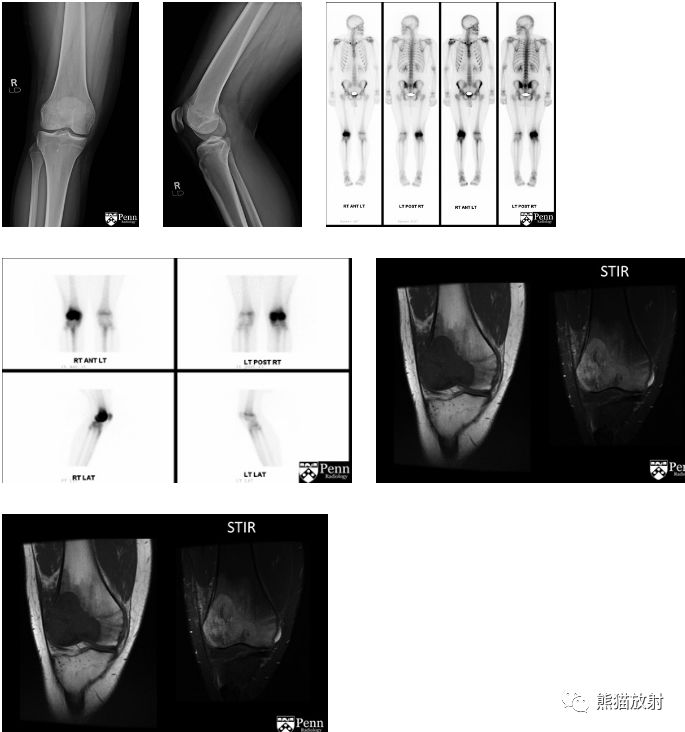
Frontal and lateral radiographs of the right knee are shown below. 右膝正侧位片如下所示。

Additional history: The patient was initially treated with conservative management. The pain persisted and slowly worsened over the next three months. The patient was subsequently evaluated with a nuclear medicine study.
补充病史:患者最初接受保守治疗。 在接下来的三个月里,疼痛持续并缓慢恶化。 随后对患者行核医学检查。
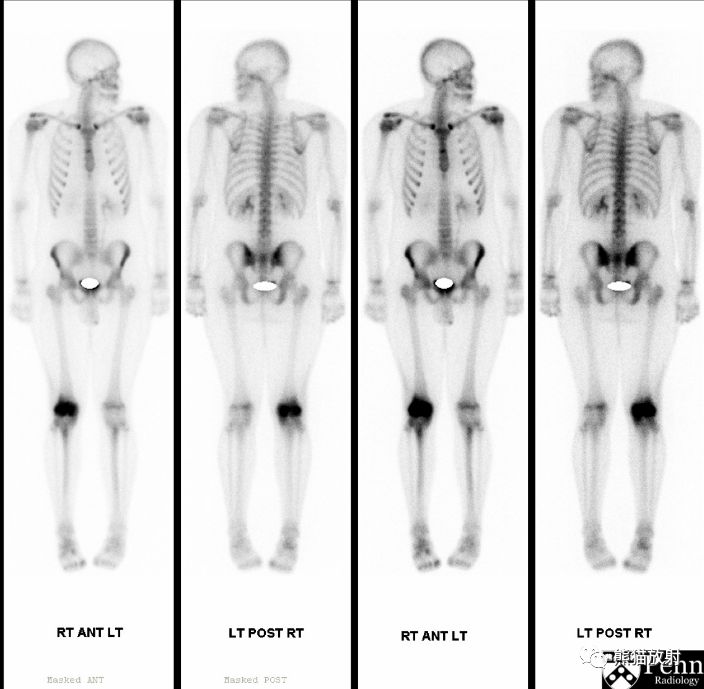
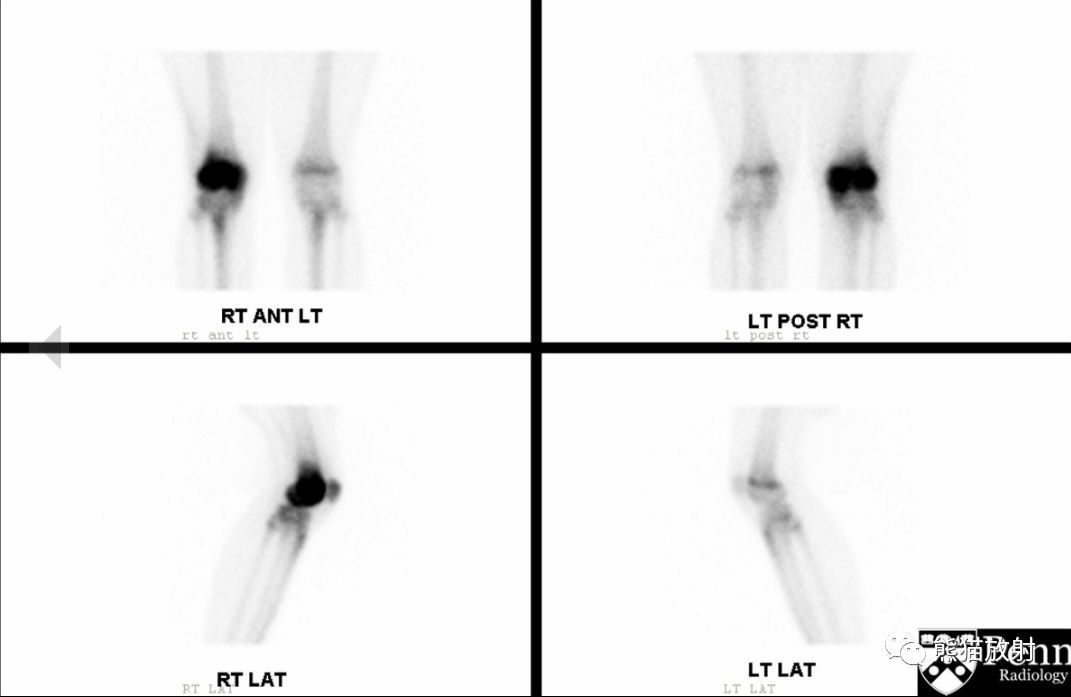
Frontal and posterior whole-body scintigrams and spot views of the knees are shown below. 全身前后位及右膝局部放大骨扫描图如下。
MR images
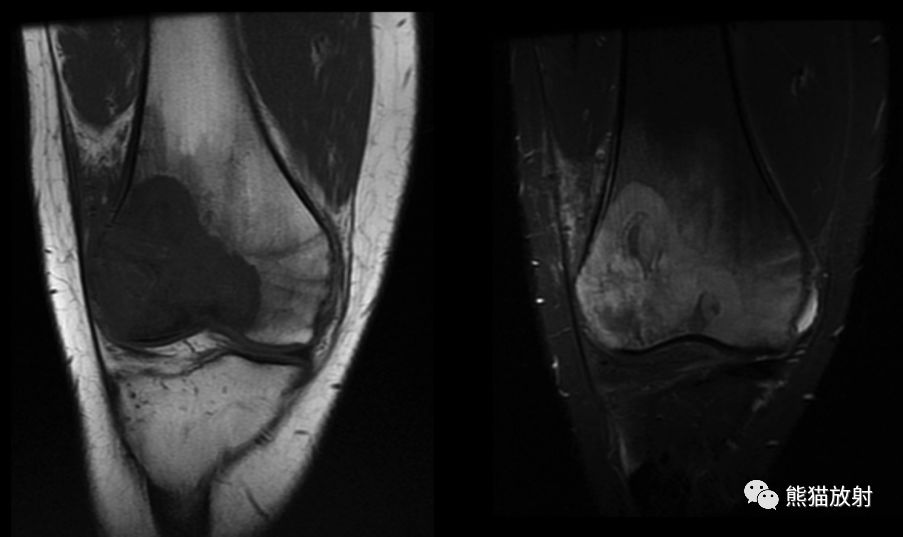
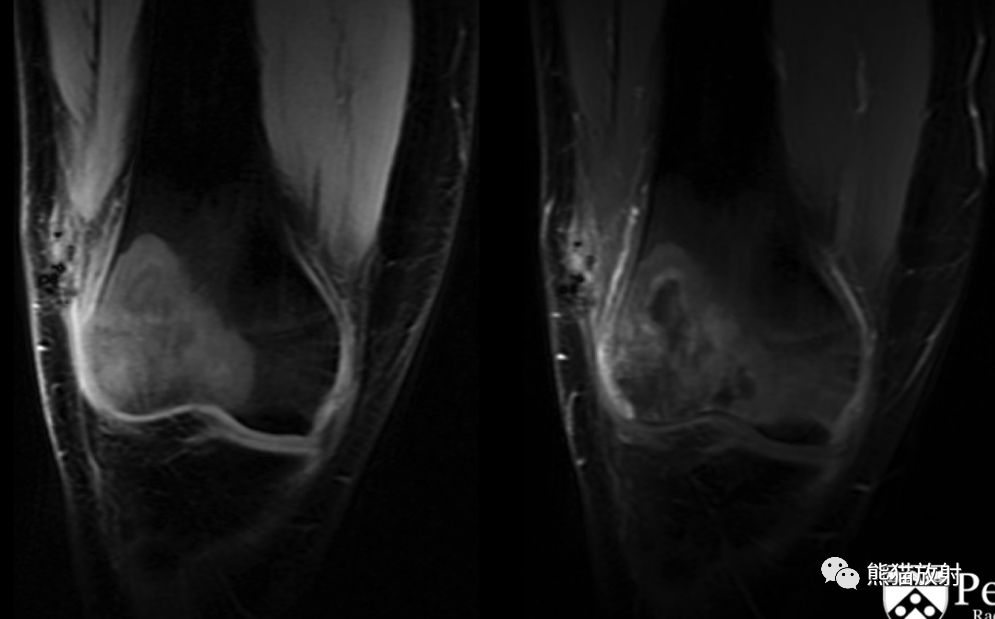
An MRI scan of the right knee with and without contrast was performed. In order: T1-weighted and short tau inversion-recovery (STIR) images and “water lava flex” pre- and postcontrast images.
行右膝MRI平扫 增强扫描。分别为:T1WI、T2-STIR、平扫 增强图像。
Additional history: The patient\’s knee effusion was aspirated and demonstrated the following results:
病史补充:吸取患者的膝关节积液,化验结果如下:
- Greater than 250,000 red blood cells 大于250,000个红细胞
- 180 white blood cells (predominantly lymphocytes) 180个白细胞(主要是淋巴细胞)
Staging studies: Staging studies, including F-18 FDG PET/CT, were negative. No other suspicious lesions were identified.
分期研究:包括F-18 FDG PET / CT在内的分期研究均为阴性。 没有发现其他可疑病变。
Findings
- Radiographs: Within normal limits.
- Bone scan: Focal increased osteoblastic activity is seen within the distal right femur.
- MRI: Bone marrow-occupying mass is seen within the distal right femur. It is hypointense to marrow on T1-weighted sequences and hyperintense on STIR sequences. The mass demonstrates mild heterogeneous enhancement with regions of central nonenhancement. There is also surrounding periosteal enhancement.
影像表现:
- 平片:未见明显异常;
- 骨扫描:右股骨远端可见成骨细胞活动增加。
- MRI:在右股骨远端可见骨髓内被肿物占据。 在T1WI上信号低于骨髓,在STIR序列上呈高信号。增强扫描呈轻度不均质强化,中央可见无强化区,周围骨膜有强化。
Differential diagnosis
- Primary bone lymphoma
- Ewing sarcoma
- Metastatic disease
- Secondary osseous lymphoma
- Osteomyelitis
鉴别诊断:
- 原发性骨淋巴瘤
- 尤文氏肉瘤
- 转移瘤
- 继发性骨淋巴瘤
- 骨髓炎
Diagnosis: Primary non-Hodgkin\’s lymphoma of the bone, diffuse large B-cell type
最后诊断:骨原发性非霍奇金淋巴瘤(弥漫大B细胞型)
Key points
Primary bone lymphoma
原发性骨淋巴瘤
Pathophysiology
- Primary bone lymphoma is an extranodal lymphoma that arises from the medullary cavity.
- The cause is unknown. Possible causes that have been suggested include inherited factors, immunodeficiency, viral infection, organ transplantation, and Paget’s disease of the bone.
- Majority of cases are non-Hodgkin\’s lymphoma of B-cell origin.
病理生理学
- 原发性骨淋巴瘤是起源于髓腔的结外淋巴瘤。
- 病因不明,已经提出的可能性病因包括遗传因素,免疫缺陷,病毒感染,器官移植和骨佩吉特病。
- 多数病例是B细胞来源的非霍奇金淋巴瘤(NHL)。
Epidemiology
- It is a rare condition.
- It comprises 3% of primary malignant bone tumors and 1% of all malignant lymphomas.
- It occurs in a broad age range of patients with the majority of cases in patients older than 45 years old.
- There is a slight male predominance (male-to-female ratio: 1.8:1.2).
- Favors long bones with persistent bone marrow: The femur is the most affected site (50%). The pelvis is the second most common site (20%).
流行病学
- 是一种罕见病;
- 占原发恶性骨肿瘤的3%,占所有恶性淋巴瘤的1%;
- 发病年龄较广,大部分见于45岁以上的患者;
- 男性略占优势(男女比例为1.8:1.2)。
- 主要累及长骨骨髓:股骨是最常见的部位(50%),骨盆是第二常见的部位(20%)。
Clinical presentation
- Common presentation symptoms include local bone pain (insidious and intermittent that may persist for months), soft-tissue swelling, mass, pathologic fracture, or hypercalcemic crisis.
- Classic B symptoms are rare.
- Diagnosis implies the absence of nodal or disseminated disease.
临床表现
- 常见症状包括局部骨痛(隐匿性和间歇性,可能持续数月),软组织肿胀,肿块,病理性骨折或高钙血症危象;
- 经典B症状很少见;
- 原发性的诊断意味着没有淋巴结或播散性疾病。
Imaging features
Radiographs — variable appearance:
- Near-normal
- Focal lytic lesion with geographic margins
- Mixed lytic-sclerotic lesion
- Permeative process with cortical destruction and soft-tissue extension
MRI:
- Low signal on T1-weighted imaging
- High signal on T2-weighted imaging — Regions of fibrosis will have low T2 signal.
- Regions of enhancement on postcontrast imaging
- Bone marrow
- Soft-tissue involvement — Often seen with lesions that demonstrate a permeative pattern on radiographs.
- Cortical erosion
Bone scan:
- 98% demonstrate increased radiotracer uptake.
- Useful for staging.
影像表现:
平片(表现不一):
- 接近正常;
- 局灶性溶骨性病变,“地图样”边缘;
- 溶骨-硬化混合性病变;
- 浸润性病变并骨皮质破坏和软组织肿胀。
MRI:
- T1WI低信号;
- T2WI高信号,局部纤维成分可表现为低信号;
- 增强后局部有强化;
- 发生在骨髓内;
- 软组织受累;
- 骨皮质破坏。
骨扫描:
- 98%表现为放射性示踪剂摄取增加;
- 可用于分期。
Treatment
- There is no standard consensus on a therapy regimen.
- Treatment is predominantly with chemotherapy, radiotherapy, or a combination of chemotherapy followed by adjuvant radiation therapy.
- Studies have shown improved survival with a combination chemotherapy and radiation therapy compared with chemotherapy or radiation therapy alone.
治疗:
- 治疗方案没有标准共识;
- 治疗方法主要是化疗,放疗或化疗联合辅助放疗;
- 研究表明,联合化疗和放射治疗与单独化疗或放疗相比,生存率有所提高。