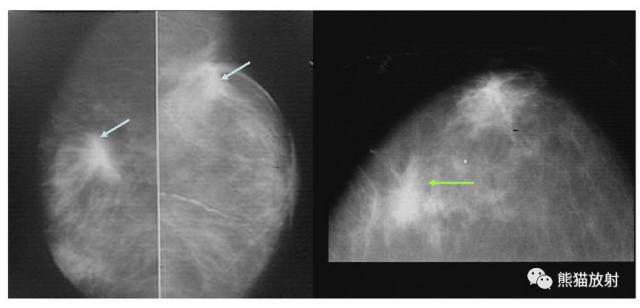
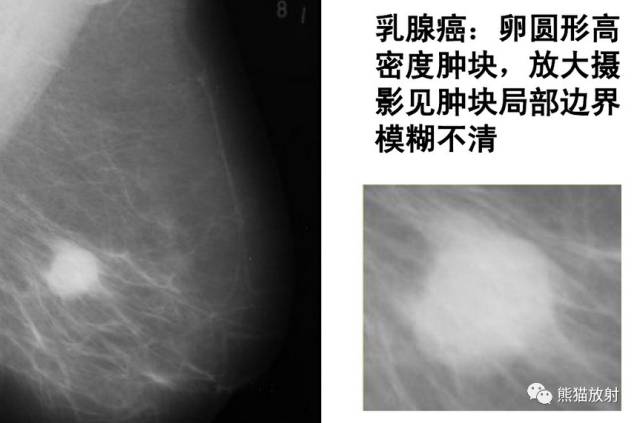
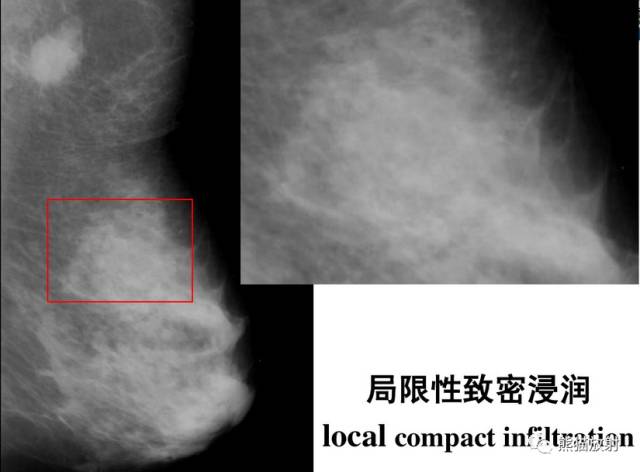
History: A young woman presents with chest pain.
病史:年轻女性,胸部疼痛。
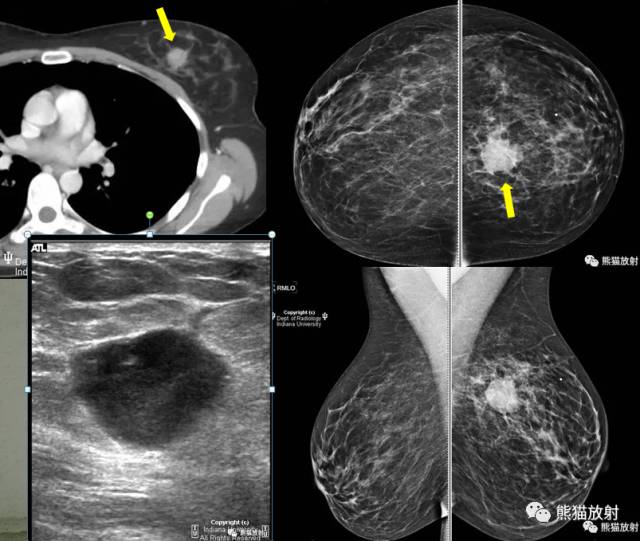
CT images are shown below. CT图像如下所示。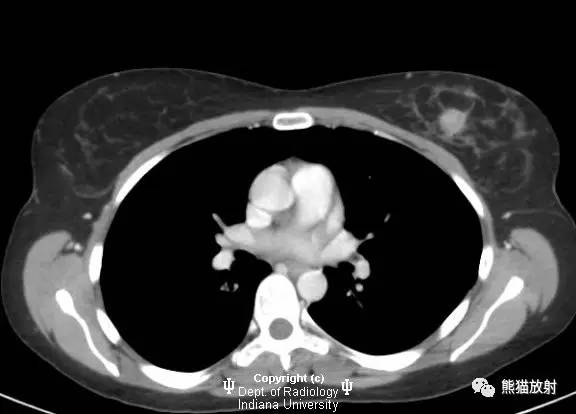

Breast images
On physical exam, a palpable left breast mass was noted at approximately the 11 o\’clock position, 4 cm from the nipple.
体格检查:左乳约11点位距离乳头4cm可触及一肿物。
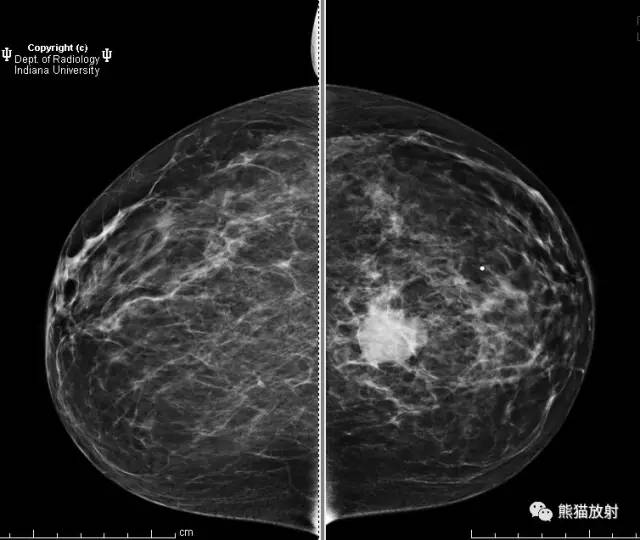
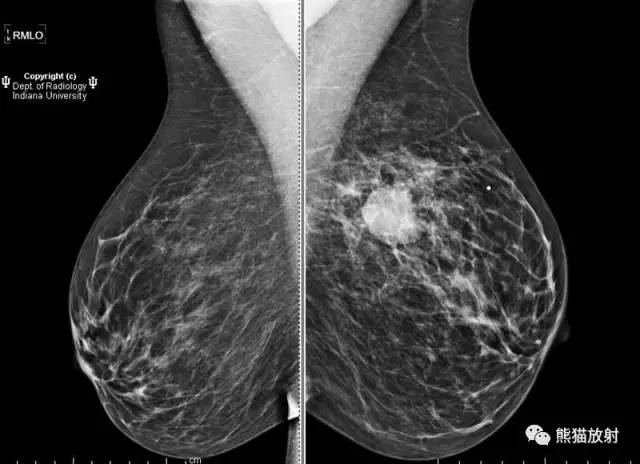
Mammography and ultrasound images are shown below.
乳腺钼靶及超声图像如下所示。

Findings
- Mammography: There is a 3.1-cm oval, isodense partially circumscribed mass in the left upper inner quadrant.
- Ultrasound: There is a 2.5 x 2.1 x 1.9-cm mixed-echogenicity, wider-than-tall, circumscribed mass with posterior acoustic enhancement.
影像表现
乳腺钼靶:左乳内上象限可见一直径约3.1cm类圆形肿物。
超声:见一大小约2.5 x 2.1 x 1.9cm的混合回声的类圆形肿物,后方回声增强。
Differential diagnosis
- Invasive ductal carcinoma
- Fat necrosis
- Fibroadenoma
- Galactocele
鉴别诊断
- 浸润性导管癌
- 脂肪坏死
- 纤维腺瘤
- 积乳囊肿
Diagnosis: Invasive ductal carcinoma
诊断:浸润性导管癌
Discussion
Invasive ductal carcinoma
浸润性导管癌
Invasive ductal carcinoma is the most common form of breast cancer (80%). It is believed to arise from ductal carcinoma in situ. There is malignant spread through the dermal lymphatics that can lead to skin thickening and nipple retraction. The cancer is often asymptomatic and found through screening. It has the highest incidence in women in their mid to late 50s and represents the most common breast cancer in men. Lymph node involvement indicates a poor prognosis. Diagnosis is usually made with ultrasound-guided or stereotactic biopsy of the mass.
浸润性导管癌是最常见的乳腺癌(80%),起源于导管原位癌,沿皮肤淋巴管播散可导致皮肤增厚及乳头内陷。临床上常无症状,影像检查时发现。50岁以上女性中发病率最高,也是最常见的男性乳腺癌。淋巴结转移代表预后差。常借助超声引导下或立体定位穿刺活检来定性。
Radiologic overview of the diagnosis
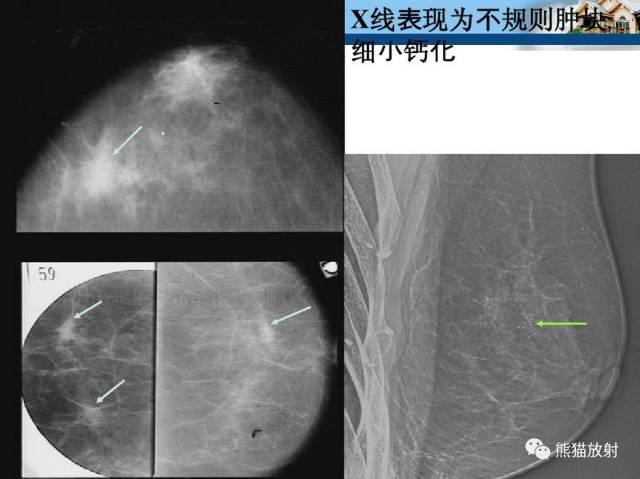
On mammography, an irregularly shaped mass with spiculated margins is most often seen. Architectural distortion and fine linear or pleomorphic calcifications can also be seen. On ultrasound, an irregular hypoechoic mass with an echogenic halo is the usual appearance. If MR imaging is performed, there is intense early enhancement of the mass with contrast and washout.
Mammography remains the screening study of choice in women age 40 and older, with ultrasound and MRI used when a suspicious lesion is seen on mammogram or when the patient is young and/or has a strong history of breast cancer (< 30 years). In this case, the patient had a palpable breast mass. The mammogram and ultrasound findings do not possess the classic findings of a ductal carcinoma but the mass appeared suspicious enough on mammogram and ultrasound to warrant a biopsy. 影像诊断综述
乳腺钼靶上常表现为不规则形肿物,边缘有毛刺。结构扭曲,可见细小或多形性钙化。超声上表现为不规则低回声肿物,周围可见回声晕。MRI上肿瘤表现为早期明显强化,然后廓清。
40岁以上女性应首先选择乳腺钼靶检查,当发现可疑病变时,或当患者比较年轻或有乳腺癌病史(30年以内)时,应行超声及MRI扫描。本例中,患者有可触及的乳腺肿物,钼靶及超声上并非为典型的导管癌表现,但足够可疑,需活检证实。
Treatment
Treatment is primarily surgical for localized disease. Radiation, chemotherapy, and hormonal therapy also are used.
治疗:受限选择手术切除局部肿瘤,再辅以放疗、化疗及激素治疗。
Key points
- Invasive ductal carcinoma is the most common form of breast cancer in women and men.
- Invasive ductal carcinoma appears as an irregularly shaped mass with spiculated margins on mammography. There may be associated architectural distortion or fine calcifications.
- On ultrasound, it appears as an irregular hypoechoic mass with an echogenic halo.
- Mammography remains the screening modality of choice in women 40 years or older. Ultrasound and MRI are useful in further evaluating suspicious lesions on mammography and young patients with breast tissue too dense for mammography.
关键点
- 浸润性导管癌是女性和男性最常见的乳腺癌;
- 在乳腺钼靶上表现为不规则形肿物,边缘有毛刺,可合并结构扭曲或细小钙化。
- 超声上表现为不规则低回声肿物,周围有回声晕;
- 40岁以上女性首先乳腺钼靶检查,当发现可疑病变时,行超声及MRI检查;年轻患者因乳腺组织太过致密不适合钼靶检查,也可选择超声及MRI检查。