History: A 26-year-old man with loss of consciousness after being struck by an automobile as he was walking.
病史:26岁男性,步行时被汽车碰撞,意识丧失。
Axial head CT images in soft-tissue window are shown below.
头颅CT轴位软组织窗如下所示。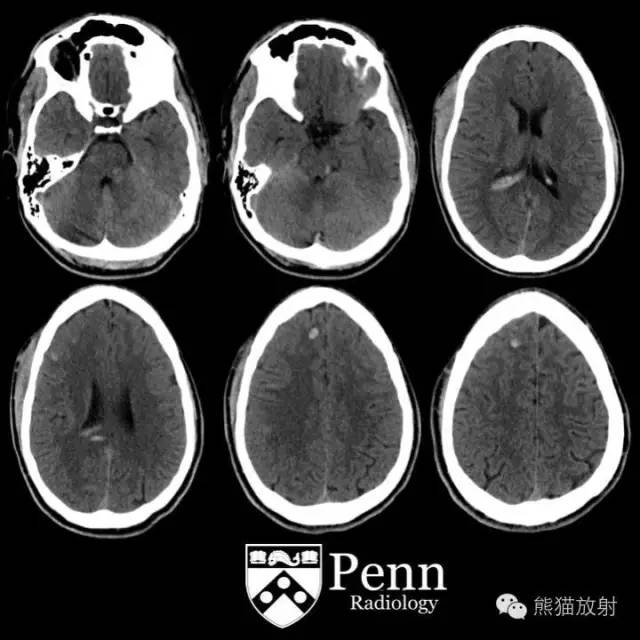
MR images
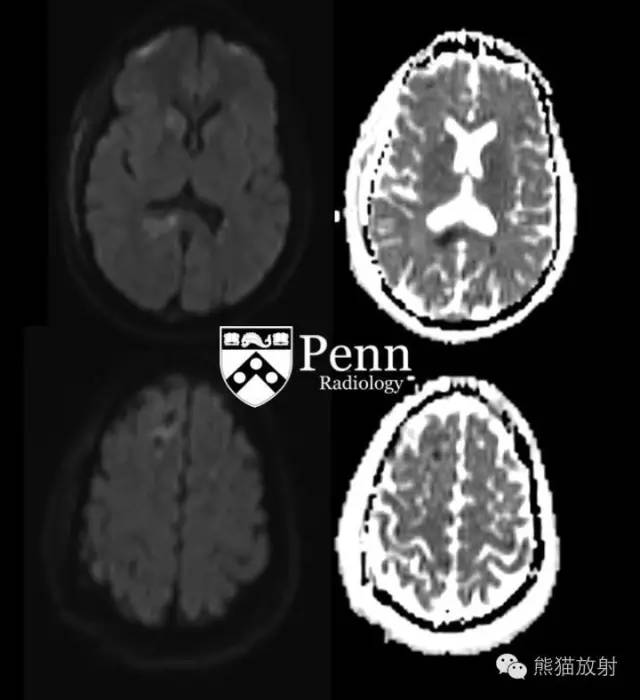
After a right, frontal approach ventricular drain was placed and the patient was stabilized,brain MRI was performed. Axial T1-, T2-, and T2-weighted fluid-attenuated inversion-recovery (FLAIR), diffusion-weighted (DWI), apparent diffusioncoefficient (ADC), and gradient-recalled echo (GRE) MR images of the head are shown below.
右额入路行脑室引流,病人状态稳定后,行颅脑MRI扫描。
轴位T1WI、T2WI、T2水抑制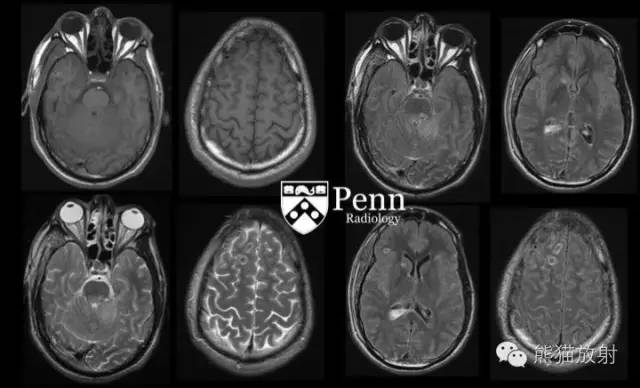
DWI、ADC图
 梯度回波成像
(磁敏感加权成像 SWI)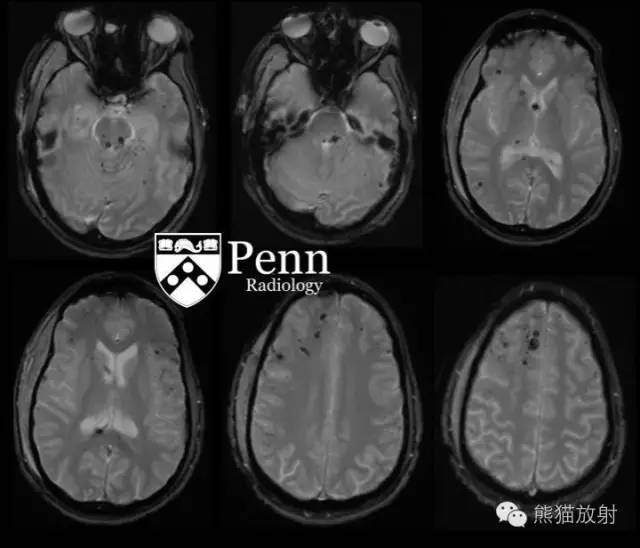
Findings
Head CT: Significant soft-tissue swelling is seen over the right temporoparietal convexity. Multiple hyperdense foci are seen throughout the brain, predominantly in the white matter and gray-white junction in the right frontal and parietal lobes. There is a hyperdense lesion in the left brainstem extending into the left cerebellar peduncle. There is also a hyperdense lesion in the splenium of the corpus callosum, extending into the ventricle. These findings are consistent with intraparenchymal hemorrhages secondary to diffuse axonal injury. There is also a small area of subarachnoid hemorrhage along the right frontal lobe.
Brain MRI: A right, frontal approach ventricular drain was placed. There is layering interventricular hemorrhage in occipital horns bilaterally, the right greater than the left. Numerous scattered foci of susceptibility artifact representing hemorrhages are seen in bilateral cerebral hemispheres, splenium of the corpus callosum, dorsolateral right midbrain, and pons, compatible with extensive diffuse axonal injury. The lesion in the splenium and several right frontal lesions demonstrate restricted diffusion.
影像表现
CT:右侧颞顶部软组织肿胀;脑内多发高密度灶,右额顶叶脑白质和灰白质交界处为著;左侧脑干见一高密度灶,累及左侧小脑脚。胼胝体压部见一高密度灶,累及脑室。上述表现为弥漫性轴索损伤脑实质内出血,另右额叶可见少量蛛网膜下腔出血。
MRI:右额入路脑室引流后所见。双侧侧脑室枕角内出血可见分层表现,右侧为著。双侧大脑半球、胼胝体压部、中脑右背外侧、脑桥见多发散在磁敏感伪影,提示弥漫性轴索损伤广泛出血灶。胼胝体压部及右额叶多发病灶表现为弥散受限。
Differential diagnosis
- Intraparenchymal contusions
- Diffuse axonal injury(DAI)
- Hemorrhagic vascular lesions from amyloid angiopathy
- Multiple cerebral cavernous venous malformations
- Hemorrhagic metastases
鉴别诊断:
- 脑挫伤
- 弥漫性轴索损伤
- 淀粉样脑血管病-出血性血管病变
- 多发脑海绵状静脉畸形
- 出血性转移瘤
Diagnosis: Diffuse axonal injury
最后诊断:弥漫性轴索损伤
Discussion
Epidemiology and pathogenesis
Traumatic brain injury (TBI) is responsible for one-third of all injury-related deaths in the U.S. TBI is most common in young men, and the most common causes are falls, motor vehicle accidents, collisions with moving objects, and sports-related injuries.
Forms of traumatic brain injury include skull fractures, extra-axial hemorrhage (epidural, subdural, and subarachnoid), cerebral contusions, and diffuse axonal injury. Diffuse axonal injury is a form of severe parenchymal injury that results from shearing forces from high-magnitude rotational acceleration or deceleration. Because the specific gravities of gray and white matter are slightly different, they have differential changes in velocity from a sudden angular rotation, which tends to cause shearing damage to the axons at the gray-white boundary. Diffuse axonal injury is usually associated with a complete loss of consciousness, but less severe forms are associated with complete or partial lucid intervals after TBI.
流行病学和发病机理
创伤性脑损伤占美国外伤相关死亡的三分之一,常见于年轻男性,常见原因有跌落、摩托车事故、快速移动碰撞、体育相关损伤。
脑外伤的形式包括:颅骨骨折、脑外出血(硬膜外、硬膜下、蛛网膜下腔)、脑挫伤、弥漫性轴索损伤。
弥漫性轴索损伤是一种由于加速或减速中强力旋转造成的剪切力所致的严重的脑实质损伤。由于脑灰白质的重力存在轻微的差异,运动中突然角旋转造成不同的速度改变,在脑灰白质交界处易导致剪切损伤。
弥漫性轴索损伤常表现为意识丧失,少部分在创伤性脑损伤后可有完全或部分的意识清醒期。
Imaging findings
Diffuse axona linjury is characterized by multiple focal lesions, usually seen at the gray-white matter junction, corpus callosum, and brainstem. Cortical lesions are more common in the frontal and temporal lobes. The splenium of the corpus callosum is most common, because this portion of the callosum is relatively mobile.
MRI is much moresensitive than CT for imaging of diffuse axonal injuries. Delayed imaging mayalso be abnormal when initial imaging is normal.
影像表现:
弥漫性轴索损伤主要特点为灰白质交界处、胼胝体及脑干多发局灶性病变。皮质病灶多见于额、颞叶,胼胝体压部为最常见部位,由于胼胝体此部位相对移动度较大。
CT findings:
Lesions are usually seen on CT if hemorrhagic, and they will appear as hyperdense oval or elliptical lesions that range in size from a few millimeters to a few centimeters.
CT is relatively insensitive for diffuse axonal injuries, especially in milder cases and if lesions are nonhemorrhagic.
If lesions are large enough, they may be surrounded by areas of hypoattenuation (representing edema) and may cause mild, local mass effect.
There is a high association with callosal diffuse axonal injury and intraventricular hemorrhage.
CT表现:
出血性病灶在CT上表现为类圆形较高密度,大小从几毫米至几厘米。
对于病情较轻或病灶没有出血的弥漫性轴索损伤,CT敏感性较差。
如果病灶较大,其周围可见片状低密度水肿区,可合并轻度占位效应。
易出现胼胝体损伤及脑室内出血。
MRI findings:
SWI/GRE sequences are the most sensitive for even tiny hemorrhagic lesions as they will show susceptibility artifact in regions with blood/hemosiderin.
Nonhemorrhagic lesions will show high FLAIR signal, representing edema.
Even without a positive MRI, diffuse axonal injury is not entirely excluded as the actual diagnosis is based on the pathologic finding of axonal bulbs (irregular swelling) microscopically.
MR spectroscopy can be used to better quantify the amount of damage.
MRI表现:
SWI/GRE序列对于微小出血灶最为敏感,含铁血黄素沉积区域可见磁敏感伪影。
没有出血的病灶在水抑制像上呈高信号,提示水肿。
即使MRI没有阳性表现,弥漫性轴索损伤也不能完全除外,实际诊断要基于镜下轴突不规则肿胀的病理学表现。
MRS可用来给损伤程度进行定量分析。
Diffuse axonal injury grading system (Adams et al, 1999)
- Grade I: Lesion involves gray-white interfaces; most often in parasagittal frontal lobes and periventricular temporal lobe.
- Grade II: Involves the corpus callosum in addition to grade 1 location.
- Grade III: Involves brainstem in addition to grade 1 and 2 locations.
弥漫性轴索损伤分级标准:
- I级:病灶累及灰白质交界处,多见于中线旁额叶及颞叶脑室周围;
- II级:除了上述部位外,胼胝体同时受累;
- III级:除了上述部位外,脑干同时受累。
Treatment and prognosis
The prognosis of diffuse axonal injury is generally poor for higher grades, with high morbidity and mortality, often with death or persistent vegetative states. The amount of axonal injury is highly predictive of long-term vegetative state. However, in mild cases, patients may be minimally affected. Diffuse axonal injury lesions in the cerebral cortex can also result in focal neurologic and/or neuropsychiatric deficits. Aside from limiting further damage caused by cerebral edema with steroids and other supportive treatments, as well as long-term rehabilitation, there are no treatments for diffuse axonal injuries.
治疗及预后
级别较重的弥漫性轴索损伤预后差,有较高的发病率及死亡率,常导致死亡或持续性植物状态。大量的轴索损伤患者发展为长期植物状态。病情较轻的患者,如果表现为脑皮层病变,结果会导致一定的神经心理缺陷。常使用激素和支持治疗来控制由于脑水肿导致的脑损伤,并结合长期康复治疗,除此之外,没有更多的治疗手段。